Z value calculations
Calculating the Z-value provides a way to test if the null hypothesis should be rejected or not. On the numerator of the formula shown, we have x̄, which denotes the sample mean, and µ₀ is the mean of the null hypothesis. On the denominator, σ is the known standard deviation, and √n is the square root of the sample size.
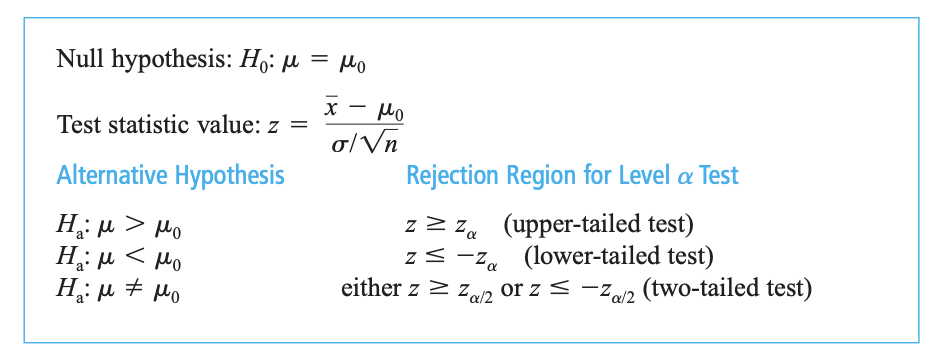
Let's do an example. A worker claims that the true temperature for a mechanical system should
operate at 130°F. A sample of n=9 systems were tested, revealing a temperature of 131.08°F. If
the standard deviation is 1.5°F, does the data contradict the worker's claim? Assume a significance level α = .01.
 The worker is claiming that it does not equal the value, so it is a two-tailed test. The rejection regions are
z.005 and -z.005, where these numbers were obtained by dividing alpha by 2. Alpha/2 is an area, but we want a value from the normal distribution curve. To change this by using a calculator, go to DISTR-->invNorm, and for area, type .005.
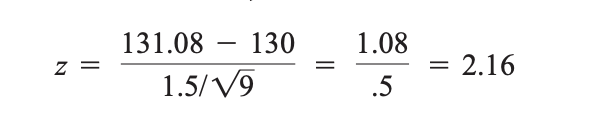
This outputs -2.57 and 2.57 for the rejection zone. Now, enter the values from the problem into the formula to calculate the Z-value.
We end up with a z value of 2.16. 2.16 does not fall in the rejection region, so we fail to reject H0.
The worker is claiming that it does not equal the value, so it is a two-tailed test. The rejection regions are
z.005 and -z.005, where these numbers were obtained by dividing alpha by 2. Alpha/2 is an area, but we want a value from the normal distribution curve. To change this by using a calculator, go to DISTR-->invNorm, and for area, type .005.
This outputs -2.57 and 2.57 for the rejection zone. Now, enter the values from the problem into the formula to calculate the Z-value.
We end up with a z value of 2.16. 2.16 does not fall in the rejection region, so we fail to reject H0.