P-value calculations
Another way to test hypotheses is using P-values. P-values have an advantage over Z-values, in which they give the strength of the evidence against the null hypothesis. P-values are a probability calculated on the assumption that H0 is true. P-values are calculated from Z-values; P-values are the area under the curve, and Z-values are a point on the curve.
An example calculation is that an integrated circuit calls for 245µm thick silicon wafers. A sample of 50 resulted in a mean thickness of 245.18 µm with a sample standard deviation of 3.60µm. Does the sample infer that the actual average silicon wafer thickness is something else other than what is currently being used? alpha = .01.
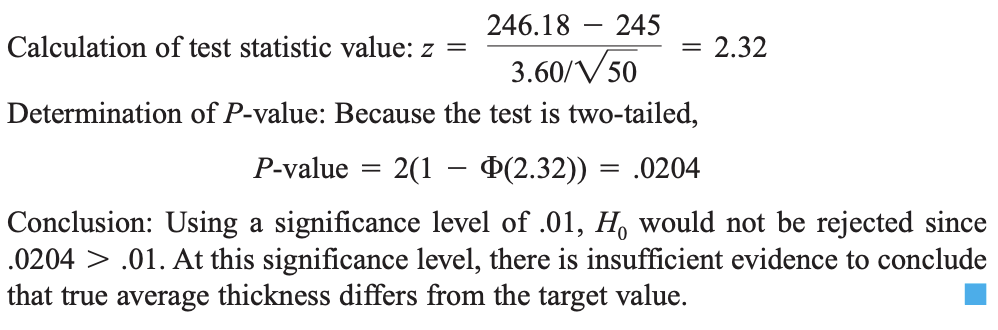
First, the null hypothesis claims that the µ =245. The alternate hypothesis claims that µ≠45. The calculated Z-score = 2.32. This is a two-tailed test. To calculate this, go to DISTR->normalcdf( -> lower:-1000000 upper:-2.32 and paste. The calculated value is .01017. We only calculated the left side of the tail; therefore, we must multiply by two for the right. The p value is .02034, and because it is greater than .01, it does not fall in the rejection zone. Thus, we fail to reject H0.